






Philippines Trade Update: Imports weaken on tepid demand
 DOWNLOAD
Policy Rate Updates: BSP outlook — cloudy with a chance of rate cut
DOWNLOAD
January Economic Update: Growth slows, prices rise
DOWNLOAD


PH secures USD 1.5B investment deals
 By BusinessWorld
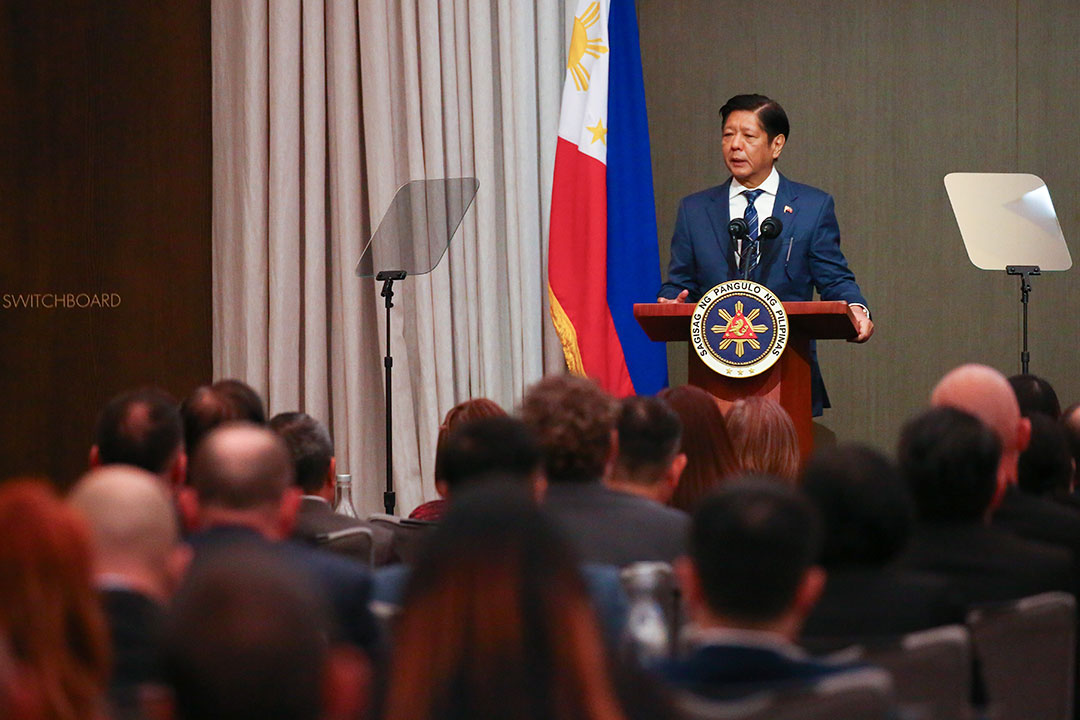


Australian companies on Monday pledged USD 1.5 billion (around PHP 86 billion) worth of investments to the Philippines, as President Ferdinand R. Marcos, Jr. sought to boost economic and security ties with Australia in the face of an increasingly aggressive China.
The Presidential Palace said in a statement that the signed deals consist of 10 memoranda of understanding (MoU) and two letters of intent from Australian business leaders who plan to invest in the Philippines.
The Philippines is an ideal destination for partnerships in manufacturing and services, Mr. Marcos told the Philippine Business Forum in Melbourne on Monday.
He also urged Australian businessmen to consider investments that would help facilitate the Philippines’ energy transition.
Among the deals signed was an MoU among Kaisan PTY Limited, the Bases Conversion and Development Authority (BCDA) and Poro Point Management Corp. for the development, construction and funding of a data center within the Poro Point Freeport Zone.
The BCDA also signed an MoU with StB Giga-Factory, Inc. for the expansion of next-generation battery manufacturing and export operations in New Clark City. It also inked MoUs with Energy Decarb PTY Limited for the deployment of “decarbonization solutions” to new Clark City Stadium, and with Passenger Urban and Rapid Electric Vehicles Solutions, Inc. for the development of electric transportation frameworks.
The Palace said Kaisan Pty Ltd also signed a memo with the Department of Human Settlements and Urban Development for the latter’s housing projects.
Paco Industries PTY Ltd, FP Paradigm Pty Ltd and Pristine Sustainable Plastics Philippines, Inc. signed a deal with the University of New South Wales on plastic recycling.
An MoU was signed between Integrated Micro Electronics, Inc. and RRR Manufacturing Pty Ltd for the manufacture of portable automated external defibrillator solutions branded as CellAED.
The National Development Company (NDC) in the Philippines and Cyclion Holdings Pty Ltd also signed a deal for the transfer of the latter’s waste-to-energy technology that converts biowaste to green fuel.
The Palace said Philippine-based companies ACEN Corp. and Ayala Corp. signed an MoU with Marubeni Australia for the development of a 200- to 400-megawatt battery energy storage system in New South Wales and with Zen Energy for a solar project in Australia.
Southern Infrastructure Pty Ltd has also signified strong interest in the development of a biomass fuel power plant with a 40-megawatt base load in the Philippines, Malacañang said.
Medgate (Asia) Holdings Pty Ltd also expressed interest in the development of artificial intelligence-driven digital health services in the Philippines “with a particular focus on tuberculosis and other respiratory illnesses.”
“It’s hard to indicate the debit side of all these agreements,” Leonardo A. Lanzona, who teaches economics at the Ateneo de Manila University, said in a Facebook Messenger chat. “Surely, these negotiations had been underway even before the trip was done.”
Mr. Lanzona said the investment pledges might have no effect on the pressing short-term issues of inflation and hunger.
“Their immediate effects on the daily needs of the poor remain questionable,” he said. “On the whole, these still do not justify the billions of travel expenses incurred by the country for these types of trips which can be handled online.”
Public investment analyst Terry L. Ridon said he is hoping these pledges will translate into actual foreign direct investments “in the soonest time.”
“The challenge to government in each and every foreign trip has always been to ensure that MoUs and letters of intent will ripen into more definitive agreements within a realistic investment timeframe,” he said in a Facebook Messenger chat.
Mr. Marcos was in Melbourne for a three-day special summit between Australia and Southeast Asian nations.
The Association of Southeast Asian Nations (ASEAN), Australia and New Zealand signed a free trade agreement (FTA) in Thailand in 2009.
Canberra and Manila are among the members of the Regional Comprehensive Economic Partnership (RCEP) agreement, which is dubbed as the world’s largest FTA.
Also on Monday, Mr. Marcos led the launch for the expansion of Victoria International Container Terminal (VICT), a unit of Razon-led International Container Terminal Services, Inc. (ICTSI).
“VICT is a Philippine success story, and I hope it will only be the beginning,” he said.
VICT, which started operations in 2017, is ICTSI’s first entry point into Australia. ICTSI is now one of the world’s largest independent terminal operators with 33 terminals in 19 countries.
The Philippines and Australia last year turned their partnership into a strategic one, as they confront authoritarian threats in the Indo-Pacific region.
Mr. Marcos said the strategic partnership would pave the way for more economic deals between the two countries.
In his address to the Australian Parliament last week, he vowed to work with Australia to keep the region stable and free, saying his country has been on the frontline of a battle for regional peace.
Mr. Marcos has veered away from his predecessor’s pivot to China, boosting Manila’s ties with the US and its Indo-Pacific allies such as Japan and Australia.
It seems the two countries have learned that reducing economic dependence on China means finding alternatives with like-minded partners, said Joshua Bernard B. Espeña, vice-president at Manila-based International Development and Security Cooperation.
“It also compels Washington to support these initiatives to strengthen the alliance network on economic grounds.”
The government of Prime Minister Anthony Norman Albanese, a Labor politician, has been dealing with a protracted trade war with China, which in 2020 began blocking the import of almost a dozen Australian goods, including wine, which accounts for USD 45.5 billion of the Australian economy.
The Philippines has been standing up to China’s intrusions in its waters in the South China Sea, and a Chinese envoy last month said the two countries’ relations now stand at a crossroad.
“The Marcos government, however, must ensure that these investments would translate into policy realities or else lose the optics needed to strengthen geoeconomic resolve in confronting China,” Mr. Espeña said.
MAHARLIKA FUND
Meanwhile, Finance chief Ralph G. Recto invited Australian investors to look at potential opportunities with the Maharlika Investment Fund (MIF).
“Australian investors seeking to broaden their portfolios into rapidly expanding markets such as the Philippines should explore potential ventures within the Fund,” he said in a speech at the Philippine Business Forum.
“It provides an opportunity for private-sector engagement in financing our big-ticket infrastructure projects,” he added.
The Maharlika Investment Corp. (MIC) is set to announce its first commitment in the next two to three months, which would likely be an energy-related project.
Its priority sectors include energy, physical and digital infrastructure, food security, aviation and aerospace, mineral processing, transportation and tourism.
Mr. Recto also invited Australian investors to explore investments in recently liberalized sectors such as telecommunications, transportation, banking, mining and energy.
“In addition, we are currently refining the country’s fiscal incentives system to further tailor-fit incentives and attract international enterprises to invest in strategically important projects,” he added.
The Finance chief also noted the Philippines’ young population and potential to become “demographic partners” with Australia.
“Our young, tech-savvy, English-speaking workforce complements Australia’s forward-thinking businesses and highly skilled labor force. This sweet spot provides an opportunity for the Philippines and Australia to become demographic partners,” he added.
He also cited growth prospects of the country, which is the fastest-growing economy in the region. — By Kyle Aristophere T. Atienza, with Luisa Maria Jacinta C. Jocson
This article originally appeared on bworldonline.com