





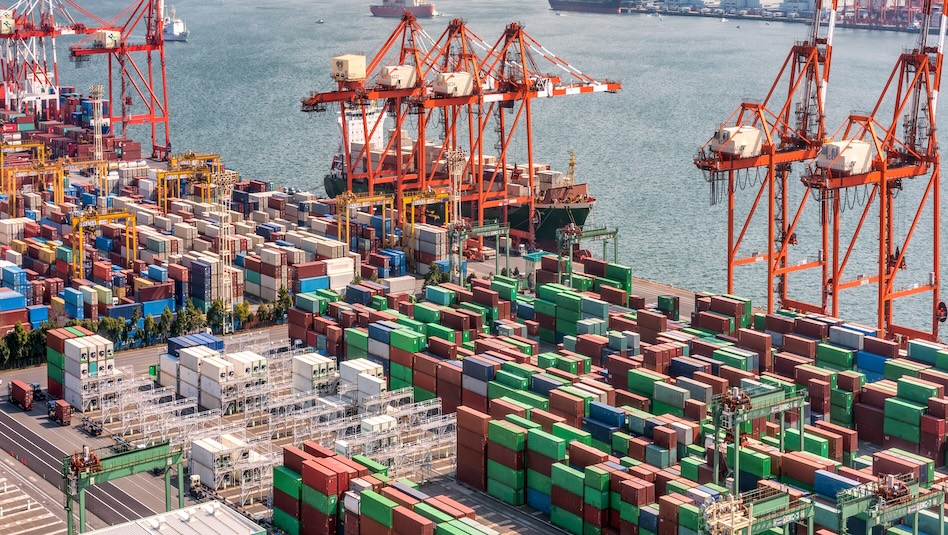
Philippines Trade Update: Imports weaken on tepid demand
 DOWNLOAD
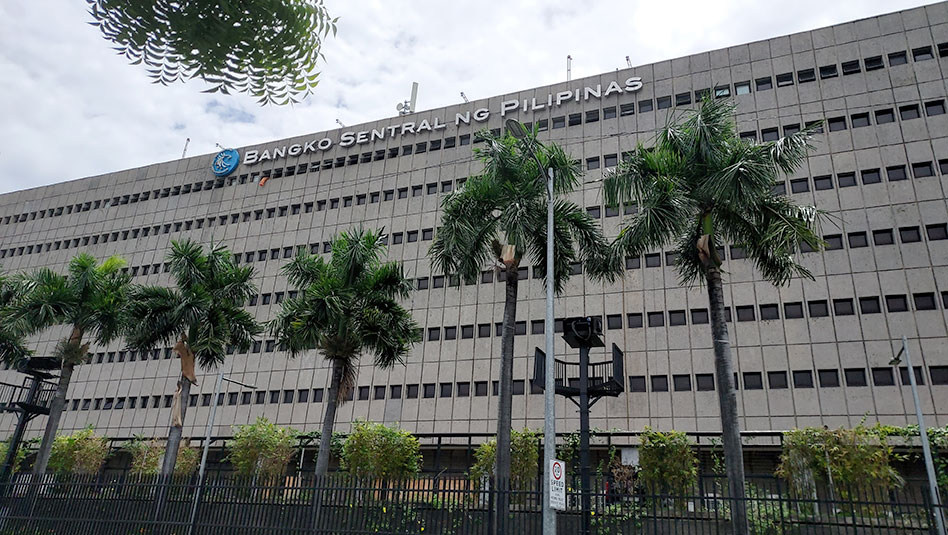
Policy Rate Updates: BSP outlook — cloudy with a chance of rate cut
DOWNLOAD
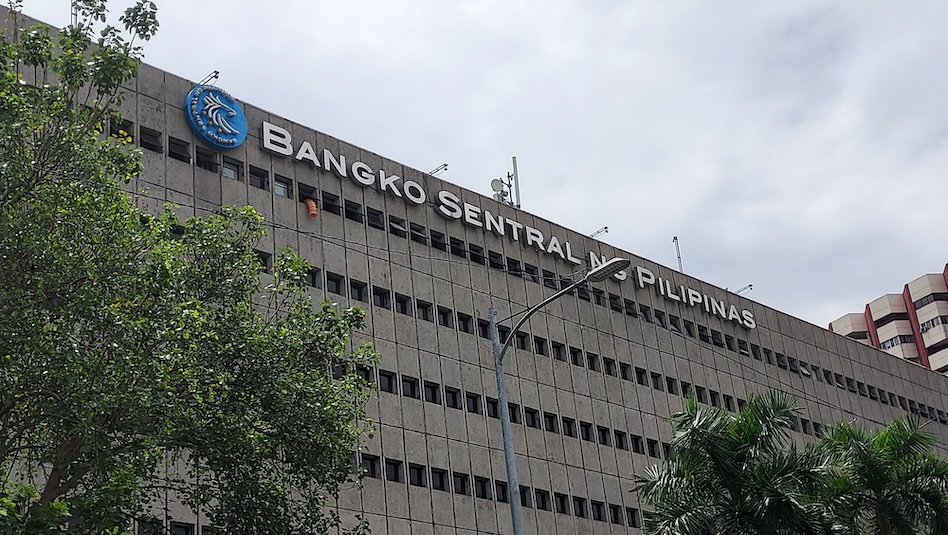
January Economic Update: Growth slows, prices rise
DOWNLOAD


PH ranking improves in global corruption index
 By BusinessWorld


The Philippines’ ranking in a global corruption index by Transparency International inched up one spot with its score remaining at a record low, as Filipino governance experts said any significant improvement is unlikely in the near future.
Manila ranked 115th out of 180 countries with a score of 34 in the 2023 Corruption Perceptions Index (CPI), up one spot from 116th in 2022 and up two spots from its worst-ever showing of 117th place in 2021. The Philippines had ranked 115th in 2020, 113th in 2019, and 99th in 2018.
The Philippines’ score of 34 is also well below the global average of 43 and Asia-Pacific region’s average of 45.
Among Asia-Pacific countries, the Philippines’ score lagged behind New Zealand (83), Singapore (83), Australia (75), Hong Kong (75), Japan (73), Bhutan (68), Taiwan (67), South Korea (63), and Malaysia (50). It also lagged Timor-Leste (43), China (42), Vietnam (41), India (39), Nepal (35), and Thailand (35).
Like the Philippines, Indonesia, and Sri Lanka also had a score of 34.
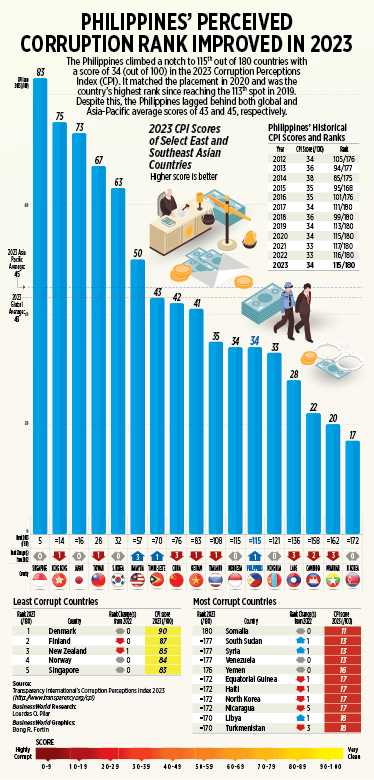
Manila was only ahead of Mongolia (33), Pakistan (29), and Papua New Guinea (29) as well as countries with governments deemed autocratic such as Laos (28), Bangladesh (24), Cambodia (22), Afghanistan (20), Myanmar (20), and North Korea (17).
In the report, the watchdog said Southeast Asian countries have struggled to deliver on anti-corruption efforts, with the Philippines and Thailand remaining “on the lower end of the spectrum.”
It said Malaysia remained above the regional average with robust elections alongside an anti-corruption commission that has delivered on high-profile cases over the last decade.
Prospects were also bleak for Indonesia amid uncertainties on the future of its “severely disempowered” anti-corruption agency, and Vietnam, whose “promising” high-profile anti-corruption campaign has been marred “by the continued restriction of critical voices.”
The one-notch improvement in the Philippine ranking was insignificant “primarily because there is no anti-corruption program that was launched by the Marcos administration,” said Gary Ador Dionisio, dean of the De La Salle – College of Saint Benilde School of Diplomacy and Governance.
It’s “unfortunate” that the Philippine leader failed to push for programs necessary for the elimination of corruption in his second address to Congress in July last year, Ateneo School of Government Dean Philip Arnold P. Tuaño said, “and neither major initiatives in transparency and accountability have been launched.”
Mr. Marcos ran in the presidential election more than two years ago under a platform of unity which, in recent days, turned out to be a promise that is so difficult to fulfill.
His administration is now publicly challenged by the family of Vice-President Sara Duterte-Carpio, who ran in tandem with him in the 2022 elections.
Tensions between the country’s top two officials became more apparent after the President’s allies in Congress stripped Ms. Duterte’s offices as vice-president and Education secretary of proposed confidential and intelligence funds worth PHP 650 million under the 2024 national budget amid public criticism on the latter’s use of secret funds amounting to PHP 125 million in just 11 days in 2022.
During and after the election season, Mr. Marcos had been hounded by questions on the alleged failure of his family to settle a PHP 23-billion estate tax liability that had ballooned to more than PHP 200 billion due to penalties and surcharges. The 1997 Supreme Court decision ordering the heirs of the late dictator Ferdinand E. Marcos to pay the estate tax liability became final and executory on March 9, 1999.
“The lack of a comprehensive anti-corruption program simply means that the Marcos administration is afraid of the ghost of the past and even the present,” Mr. Dionisio said.
Duterte legacy
Under the Duterte administration, the Commission on Audit had flagged many agencies for their deficiencies.
“The various CoA (Commission on Audit) reports show the extent of wastage in public funds that date back to the previous administration which President Marcos and his Cabinet cannot ignore,” said Zyza Nadine Suzara, execu-tive director of governance watchdog iLead. “They need to proactively restore the international community’s trust in our public institutions.”
Francisco A. Magno, director of the Jesse M. Robredo Institute of Governance at De La Salle University, raised concern over the “slow progress” in the prosecution of high-profile cases involving irregularities in public procure-ment flagged by the state auditors and investigated by legislative oversight committees.
“There is also a weakening exercise of media and civil society monitoring of corrupt practices that became palpable under the previous administration and continues under the present one,” he said.
The National Government on Sunday held a major rally under the banner Bagong Pilipinas (New Philippines), with Mr. Marcos saying that change should start with the government.
“Being lazy and slow is not acceptable in government. There is no place for them in public service,” he said in a speech before hundreds of thousands of participants, many of whom were state employees.
“Services must be fast. Projects must be completed on time. Deadlines must be met per schedule,” he added. “Distress calls must be responded to without delay.”
Ms. Suzara said the corruption level in the Philippines is a major barrier to the entry of foreign investments into the country, as it “signals that the current Marcos Jr. administration, like its predecessor, is still not taking good governance seriously.”
“To improve our standing, the Marcos Jr. administration therefore needs to implement reforms that will strengthen transparency and accountability,” she said. “Congress must also do the same especially in performing oversight functions on the national budget.”
But for Terry L. Ridon, convenor of think tank InfraWatch PH, “the public has not yet seen a major corruption scandal involving officials at the highest levels” in Mr. Marcos’ first two years in office, “unlike the major corruption scandals in the previous regime.”
“More significantly, the business and investment climate is better today, with the successive international roadshows participated in by no less than President Marcos himself,” he added.
Mr. Dionisio said prospects for the Philippines’ anti-corruption efforts remain bleak.
“It is very unlikely that we will have a radical improvement of our CPI standing the way our governance is unfolding.” — By Kyle Aristophere T. Atienza, Reporter
This article originally appeared on bworldonline.com