





Philippines Trade Update: Imports weaken on tepid demand
 DOWNLOAD
Policy Rate Updates: BSP outlook — cloudy with a chance of rate cut
DOWNLOAD
January Economic Update: Growth slows, prices rise
DOWNLOAD


Marcos skips e-gaming, tariffs in SONA
 By BusinessWorld
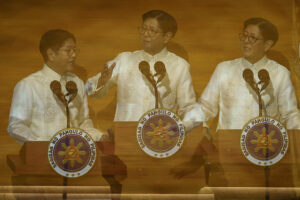


Philippine President Ferdinand R. Marcos, Jr. delivered his fourth State of the Nation Address (SONA) on Monday, notably omitting two controversial issues facing his administration: the proposed ban on online gambling and US tariff increases that threaten growth.
While the President spoke at length about economic growth, food security, energy reforms, and social services, he was silent on legislation seeking to outlaw or better regulate e-gaming.
The omission comes despite mounting concerns over e-gambling’s mounting toll on Filipino families with members grappling with addiction, and separate pending bills in the Senate and House of Representatives that seek to either ban or regulate the industry.
Mr. Marcos is facing growing public frustration as many Filipinos say the promises he made during his 2022 campaign remain largely unmet three years into his term.
He ran on a platform of economic revival, vowing to lower rice prices, strengthen agriculture and spark a new wave of industrialization. But for some Filipinos, those pledges have yet to translate into real improvements in daily life.
Mr. Marcos also made no mention of the 19% US tariffs on Philippine goods that will take effect on Aug. 1. Critics say the tariff increases disproportionately hurt low-income consumers already grappling with inflation, a concern that remains unaddressed in the administration’s economic narrative.
“Based on data, our economy is looking good,” the President said in his speech in Filipino that lasted an hour and 10 minutes, citing lower inflation and higher investor confidence.
But he acknowledged that these gains are meaningless “if our fellowmen struggle and are burdened.”
“The President’s SONA stumbled from the very start with the false premise of the economy doing well,” Jose Enrique A. Africa, executive director of IBON Foundation, said in a Viber message.
“This is in denial of slowing growth, high prices today after high inflation in his first three years, deficits and debt far above targets upon taking office, and jobs figures hiding worsening pay and quality of work,” he added.
The omission of legislative priorities is troubling and signals disinterest in growing poverty, hunger and joblessness, he added.
Philippine Chamber of Commerce and Industry Chairman George T. Barcelon said failure to act decisively on online gambling could lead to broader public safety concerns. “The government just has to be vigilant because normally when it comes to gambling, you attract the wrong kind of lawlessness,” he said by telephone.
“The SONA was a direct response to the midterms,” Ederson DT. Tapia, a political science professor at the University of Makati, said in a Facebook Messenger chat. “Most of the issues covered were those that mattered to the least, lost and last. He avoided topics that can be divisive too.”
The President reiterated his commitment to job creation, small business support and agriculture. He said the administration had proven that rice could be sold at PHP 20 per kilo without hurting farmers, citing limited rollouts in select areas.
He vowed to expand the program nationwide through more so-called Kadiwa stores.
Despite the upbeat tone, some analysts found the speech lacking in urgency. There was no reference to more aggressive measures to protect consumers from price shocks due to tariffs.
“We commend the President for pushing his campaign promise of P20 per kilo of rice,” Jayson H. Cainglet, executive director of the Samahang Industriya ng Agrikultura, said in a Viber message.
‘Not just lip service’
He blamed the “self-inflicted disaster that is Executive Order No. 62,” which lowered rice import tariffs to 15%, as the principal culprit for the unprecedented drop in rough rice farmgate prices, noting that the landed cost of rice imports is now only PHP 23 to PHP 25 per kilo.
Mr. Cainglet said the government should raise the rough rice procurement budget to P50 billion and quickly grant cash incentives to rice farmers using the P4-billion excess funds under the Rice Competitiveness Enhancement Fund from last year.
Philippine Exporters Confederation, Inc. President Sergio R. Ortiz-Luis, Jr. said he was “happy” that Mr. Marcos mentioned initiatives to help small and medium enterprises including increased funding. “I hope that this is not just lip service,” he told BusinessWorld by telephone.
But he was hoping that the President would say something about exports. “Unfortunately, I think it wasn’t there. I’m not sure also if he mentioned anything about the tariffs.”
Mr. Marcos also touted gains in renewable energy, education, digitalization and healthcare. He announced efforts to expand electrification, free dialysis treatment and digital learning tools for public school teachers and students.
“Compared with last year, his speech did not have that ‘wow’ moment when he would surprise or put the crowd in awe,” Arjan P. Aguirre, assistant professor of political science at the Ateneo de Manila University, said via Messenger chat. “No strong takes on the pressing issues of the day.”
“The closest that we can highlight here is the mention of the flood control project, which still did not sound convincing since everything would still depend on him — no mention of institutionalizing changes like mechanisms and safeguards in the process itself,” he added.
In his speech, the President ordered the Department of Public Works and Highways (DPWH) to investigate flood control projects that failed during recent storms, calling out widespread corruption in infrastructure spending and warning of criminal charges for those found guilty.
He cited his recent inspections after the onslaught of the southwest monsoon and tropical cyclones Crising, Dante, and Emong, which exposed the collapse and dysfunction of flood mitigation systems across the country.
“I saw firsthand that many flood control projects were poorly built, collapsed, or worse — never even existed,” the President said in Filipino. “Let’s stop pretending. The public knows there was racketeering in these projects.”
Mr. Marcos accused unnamed officials and contractors of pocketing public funds through “kickbacks, initiatives, errata, SOPs (standard operating procedures), for the boys,” and called out their lack of shame.
“You should be ashamed of yourselves in front of your fellow Filipinos… especially for what you’ve done to the families whose homes were swept away or submerged in floodwaters,” he said. “You should be even more ashamed for burdening our children with debt from money you simply stole.”
To address the issue, he said the DPWH must immediately submit a list of all flood control projects launched or completed in the past three years across all regions.
Second, regional project monitoring committees will review the list to identify incomplete, substandard or ghost projects.
“We will publish this list,” Mr. Marcos said. “The public, as witnesses to these projects, will be free to review them and share what they know to help with the investigation.”
He added that an audit and performance review would accompany the probe to trace how public funds were used. “In the coming months, everyone found guilty in this investigation — along with their contractor accomplices — will face charges.”
“The people deserve to know the full truth. There must be accountability for the damage and corruption,” he said.
In a further warning to lawmakers, Mr. Marcos declared he would not approve any 2026 national budget that deviates from his government’s national expenditure program.
“I will return any proposed general appropriations bill that is not fully aligned with the national expenditure program,” he said. “I’m willing to do this even if we end up with a reenacted budget.”
“I will not approve any budget that is not aligned with the government’s plans for the Filipino people,” he added.
Leonardo A. Lanzona, an economics professor at the Ateneo de Manila University, said a reenacted budget “would never happen” given all the promises Mr. Marcos made.
“This is a contradiction,” he said in a Messenger chat. “Without any accomplishments, the President has promised to bribe us with candies to get our approval and distract us from the problems, including the high tariffs we are facing.”
The President’s remarks marked one of the strongest condemnations of government corruption in his term so far, signaling a tougher stance ahead of the 2026 budget season.
But the absence of any statement on pressing regulatory issues raised questions about the administration’s priorities. With three years left in his term, analysts and lawmakers alike are watching to see whether the President will confront these concerns head-on — or continue to sidestep them.
Mr. Barcelon said the President deserves credit for addressing inefficiencies in public works spending, and welcomed his remarks on healthcare, education, and support for farmers, calling them “all good.”
But the government’s “very high” debt is concerning, he said by telephone. “And that is something that can only be resolved if our economy would be fast-tracked from 5-6%, probably to 7-8%.”
He warned that without faster growth, the country’s rising debt burden, which stood at P16.92 trillion as of May, could derail the President’s social pledges.
“This issue of incurring such a huge debt would continue. And that might make all his promises to the people on free education, free health — everything is almost free — very challenging.”
Mr. Barcelon also expressed surprise that Mr. Marcos made no mention of the country’s trade policy with the US, calling it a missed opportunity to clarify the direction of one of the Philippines’ most important economic partnerships.
He described the overall tone of the speech as “a pep talk for the people to hear,” and reiterated that the private sector remains committed to supporting the government. — Norman P. Aquino, Special Reports Editor with Chloe Mari A. Hufana, Justine Irish D. Tabile, Kenneth Christiane L. Basilio and Adrian H. Halili
This article originally appeared on bworldonline.com